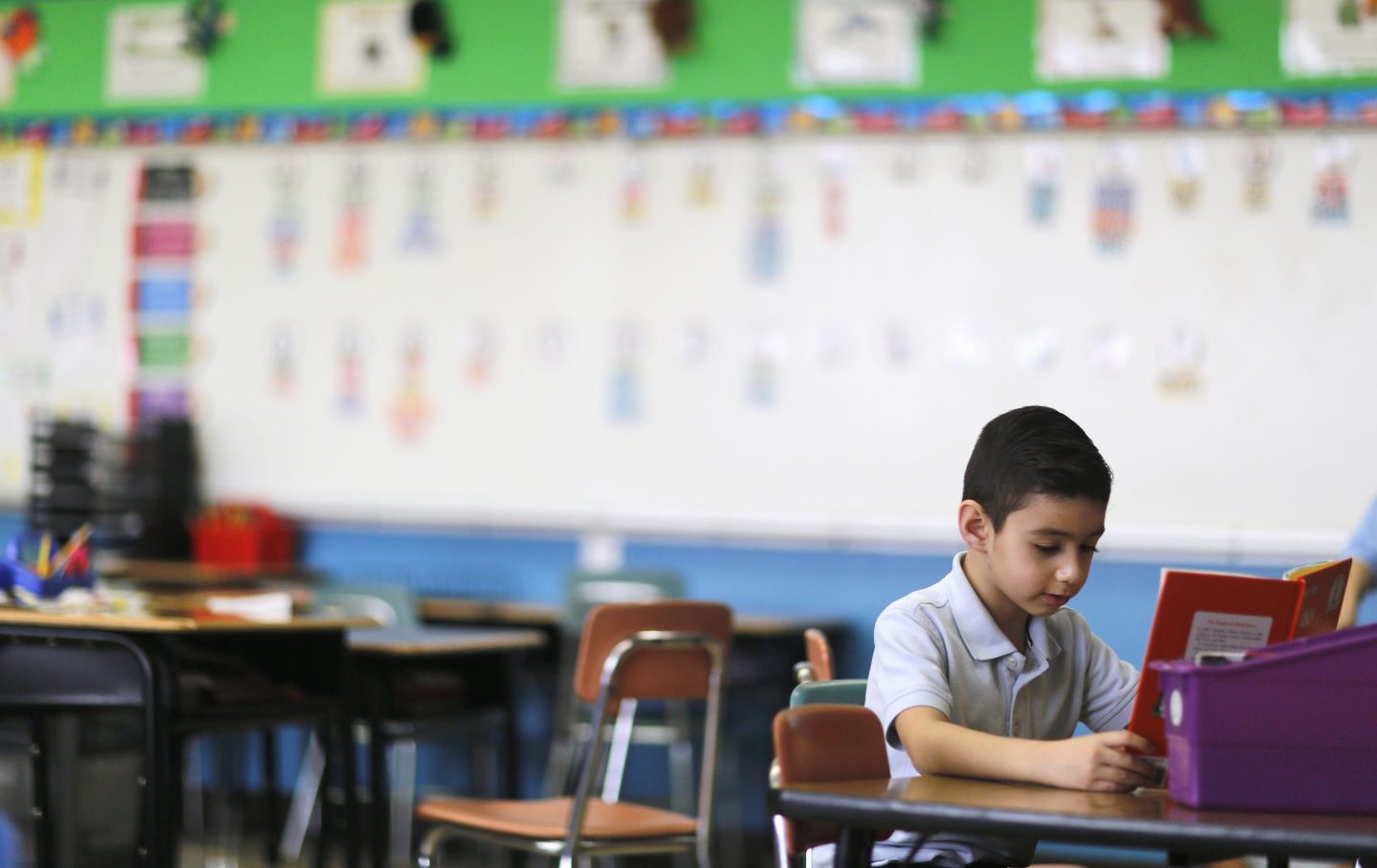
American students are in trouble. About a third of students in the youngest grades are behind on reading. Only 36% of fourth graders are proficient at grade-level math. The newest National Assessment for Educational Progress (NAEP)–the nation’s report card–shows eighth-graders’ history scores are the lowest on record since the assessment began in 1994. And what’s more, every single state experienced teacher shortages in at least one subject in 2022.
While many of these problems began before COVID-19, there’s no denying that the pandemic paused or reversed academic progress for kids across the country. The NAEP showed that for both fourth and eighth-grade students, reading scores declined in at least 30 states and jurisdictions, and math scores declined nearly everywhere from 2019 to 2022.
Perhaps most troubling is how the pandemic made existing achievement gaps worse. Stanford University researchers conducted a district-by-district analysis of the NAEP results, and found that students in low-income school districts and communities experienced the biggest learning losses.
How do we get American education back on track? A part of the solution will come from increasing the range of options that families have when choosing schools. The NAEP’s wake-up call shows that a one-size-fits-all approach isn’t working for all students.
School choice programs mean that students aren’t locked into attending a district public school based on home address. Instead, they provide parents with funds that can be used toward a broad range of options, including secular or religious private schools as well as charter schools, which are publicly funded schools that have greater autonomy.
School choice makes it possible for all students, regardless of economic background, to get an education that matches their needs and interests. Depending on the student, that could mean a smaller school, one that caters to learning differences, or one that focuses on arts, athletics, or science.
Charter schools generally outperform traditional public schools, especially in urban areas. A report from Stanford University found that students in urban charter schools received, on average, 40 additional learning days in math and 28 additional learning days in reading each year, compared to their counterparts in traditional public schools.
Meanwhile, the NAEP results showed that as a nationwide group, Catholic schools lost less ground during the pandemic than public schools, and even held steady in fourth-grade math and improved in eighth-grade reading. In fourth-grade math, they performed better than all state public school systems.
To make sure more students get the best education they can, my organization, the Daniels Fund, has committed to adding 100,000 seats to non-traditional schools by 2030, spread across the four states we serve: Colorado, New Mexico, Utah, and Wyoming. This big bet will increase the attendance capacity of non-traditional schools in our region by nearly 30%.
Each new seat will allow another student to get an education of their choice. This could be in a charter school, private school, or home-school co-op. Our investment will also allow families to choose micro-schools (small educational programs independent of school districts), learning pods (parent-organized groups that use hired instructors), or hybrid schools (which combine in-person and online learning). We’ve observed that the most significant innovations in education today are happening within these alternative models.
We’re far from alone in our efforts. In 2020, 50CAN, a national educational advocacy organization that has secured 198 policy wins for students in 15 states, provided $335 million in direct aid to families in North Carolina and gave 10,000 more children access to multiple school options in the state. ExcelinEd, an education thought and action organization that develops policy recommendations for leaders around the country, identifies equitable funding for public charter schools as a key directive.
And we know that parents want choice. From 2009 to 2019, Colorado charter schools grew by more than 85%. Nationally, 1.4 million students left district public schools during the 2020-2021 school year, with 240,000 of them choosing charter schools.
This shouldn’t come as a surprise. After Denver began expanding school choice in 2009, graduation rates and achievement in English and math improved, according to a 2021 University of Colorado report.
Too many young people are falling behind in their education. It’s time to give them more options, so they can thrive in the learning environment that’s best for them.
Hanna Skandera is the president and CEO of the Daniels Fund and former Secretary of Public Education of New Mexico.
The opinions expressed in Fortune.com commentary pieces are solely the views of their authors and do not necessarily reflect the opinions and beliefs of Fortune.
More must-read commentary published by Fortune:
- Asana CEO: ‘The way we work right now will soon look vestigial. Here’s how A.I. will make work more human’
- The alt-right economy is failing. Here’s the real performance of anti-woke entrepreneurs
- E-bike injuries: ‘We’re only seeing the tip of the iceberg,’ trauma experts warn
- A year after Roe v. Wade was overturned, an unworkable patchwork of state laws leaves corporate America more vulnerable to government overreach